

Person-Centred
Resource Hub:
Frailty
UK Key Facts and Figures

Effective treatment means that more people are living longer with HIV, the number of people with HIV who are 50-64 years old is now larger than the number of people who are 35-49 years old.1
Approximately 4–10% of people with HIV are frail, including up to 50% of people over the age of 50.2
Growing Older with HIV and Frailty
Frailty is a term used to describe a general decline in physical health and a loss of reserves. It can lead to a person being less robust and less able to bounce back after a change in health3. Frailty is more common—and can occur earlier—in people living with HIV. Fortunately, it’s a dynamic condition, meaning it can be prevented or reversed4 with the right support.
What Helps2, 6:
- Stay active: Regular movement helps maintain strength and physical function.
- Eat well: A balanced, nutrient-rich diet supports overall health.
- Stay connected: Social interaction and mental wellbeing are key.
- Address wider risks: Smoking, poverty, and isolation can increase vulnerability to frailty.
Support from a healthcare team is essential to monitor changes, offer guidance, and connect you with services that promote independence and wellbeing.
What can I ask?
A selection of questions you can ask during your consultations:

Where can I get support for my mental wellbeing?
How can I access support to live more independently?
Is it possible to work with specialists to help maintain my physical strength?
Can the clinic connect me to a peer support service?
What to expect from your health and care team…
BEING
assessed regularly as you get older to spot signs of frailty and making sure you have the support that you need.
HAVING
access to advice about changes that you can make that could help you live more independently and reduce frailty.
KNOWING
what support is available to help you make these changes. This could include nutritional support, occupational therapy, physiotherapy as well as guidance around changes to medication.
Policy & Screening
Frailty is recognised as a growing concern in ageing populations. Current guidelines recommend that all people with HIV over the age of 50 be screened annually, to understand ways to help prevent or reduce frailty as people grow older.
Supporting frailty for people growing older with HIV
Assessing and managing frailty:
- HIV services should take steps to identify frailty, followed by effective management. Signs should be looked for at every stage, and wherever people with HIV may present. While there is currently no unanimously agreed on diagnostic tool for frailty, commonly employed systems include Fried Frailty Phenotype (FFP), electronic Frailty Index (eFI), and Clinical Frailty Scale (CFS).7,8,9
- Frailty is a difficult topic for many people, and it is important that the right language is used when broaching the topic. If done sensitively and using good judgement, doing so can help people manage their frailty and prepare for the future.10
Frailty is a dynamic condition and should involve a multi-disciplinary team (MDT) to manage it. Geriatricians may lack specific knowledge and experience of HIV, as services have not historically treated people with HIV in older age.
Integrated care and joint services are therefore vital for ensuring more holistic care.
There are differences in models of care for frailty across the country, however generally frailty assessments could be carried out by an HIV clinician, geriatrician and/or pharmacist. In some cases, assessment may also include the opinion of a physiotherapist or an occupational therapist.
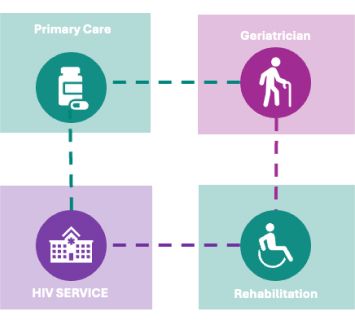

A geriatrician will have specialist knowledge of health care for older people, and experience managing frailty. They will conduct the Comprehensive Geriatric Assessment, and manage age related issues, more complex cases and manage diagnostic uncertainty.
A GP will help people with HIV manage long-term conditions such as frailty, as well as referring people to specialists in hospitals. GPs can manage less severe issues, support medication management and care coordination. Intervention at primary care level may help reduce long term ill-health, reducing hospital visits and potentially preventing frailty if identified early on.

HIV Practitioners will provide specialist oversight of care and treatment for someone living with HIV. They can help conduct frailty assessments, manage the coordination of care and also conduct medication reviews.
Specialist nurses play an important role in co-ordinating someone living with HIV’s care and assisting people to access additional support, this can include sign-posting to other services that can support with independent living, such as a needs assessment for social care.

Rehabilitation services include specialist services such as occupational therapy, speech and language therapy, physiotherapy and dietary support. Those with mild frailty or pre frailty, often benefit the most from these services where early intervention can help minimise risk factors, for example preventing falls, reducing social isolation, and ultimately delaying the progression of frailty.
Managing frailty when growing older with HIV11
The Silver Clinic is available to those living in the South-East of England who are experiencing frailty, are affected by multiple health conditions (multi-morbidity), reduced mobility, social isolation, falls or be taking lots of different medications (polypharmacy). It is a new approach for the assessment and management of people ageing with HIV.
The clinic offers:
- A comprehensive, patient-centered assessment and management plan.
- Multidisciplinary input from an HIV physician, geriatrician, specialist HIV nurse, and pharmacist.
- Ongoing in-person or virtual support.
- Referrals for further care as needed.
- British HIV Association (BHIVA) Standards of Care for People Living with HIV aims to tell you about what you should expect when getting your HIV care: https://www.standards.bhiva.org
- The NHS Rightcare: Frailty toolkit aims to support systems to understand the priorities in frailty care and key actions to take., https://www.england.nhs.uk/rightcare/wp-content/uploads/sites/40/2019/07/frailty-toolkit-june-2019-v1.pdf
- The Geriatric Medicine Research Clinical Frailty Scale which is a global clinical measure of fitness and frailty in elderly people, https://www.dal.ca/sites/gmr/our-tools/clinical-frailty-scale.html
- Geriatric Medicine Research, The Frailty Index, https://www.dal.ca/sites/gmr/our-tools/the-frailty-index.html
- Fit For Frailty Part 1, Consensus best practice guidance for the care of older people living in community and outpatient settings, https://www.bgs.org.uk/sites/default/files/content/resources/files/2018-05-23/fff_full.pdf
- Fit for Frailty Part 2, Developing, commissioning and managing services for people living with frailty in community setting, https://www.bgs.org.uk/sites/default/files/content/resources/files/2018-05-23/fff2_full.pdf
Quick Navigation


References
- National AIDS Trust. UK HIV Statistics. Available at: Available at: https://www.nat.org.uk/about-hiv/hiv-statistics#:~:text=Out%20of%20the%204%2C040%20people,men%20and%2036.4%25%20were%20women. Accessed May 2024.
- Bloch, M. Frailty in people living with HIV. Bloch AIDS Res Ther (2018) 15:19 National AIDS Trust. UK HIV Statistics. Available at: Available at: https://www.nat.org.uk/about-hiv/hiv-statistics#:~:text=Out%20of%20the%204%2C040%20people,men%20and%2036.4%25%20were%20women. Accessed May 2024.
- Aidsmap, Frailty and HIV, 2023. Available at: https://www.aidsmap.com/about-hiv/frailty-and-hiv. Accessed May 2024.
- Kojima G, Taniguchi Y, Iliffe S, Jivraj S, Walters K. Transitions between frailty states among community-dwelling older people: a systematic review and meta-analysis. Ageing Res Rev. 2019;50:81–88. Accessed May 2024.
- Desquilbet L, Margolick JB, Fried LP, Phair JP, Jamieson BD, Holloway M, Jacobson LP, Multicenter ACS. Relationship between a frailty-related phenotype and progressive deterioration of the immune system in HIV-infected men. J Acquir Immune Defic Syndr. 2009;50:299–306. Accessed May 2024.
- Aidsmap, Frailty and HIV, 2023. Available at: https://www.aidsmap.com/about-hiv/frailty-and-hiv. Accessed May 2024.
- Fried LP, Tangen CM, Walston J, et al. Frailty in older adults: evidence for a phenotype. J Gerontol A Biol Sci Med Sci. 2001;56(3). Accessed May 2024.
- NHS England. Identifying frailty. Available at: https://www.england.nhs.uk/ourwork/clinical-policy/older-people/frailty/frailty-risk-identification/
- Geriatric Medicine Research. Clinical Frailty Scale. Available at: https://www.dal.ca/sites/gmr/our-tools/clinical-frailty-scale.html. Accessed May 2024.
- NHS England. Ageing well and supporting people living with frailty. Available at: https://www.england.nhs.uk/ourwork/clinical-policy/older-people/frailty. Accessed May 2024.
- Brighton & Hove Sexual Health & Contraception Service. The Silver Clinic (Frailty). Available at : https://brightonsexualhealth.com/advice/the-silver-clinic-frailty/. Accessed May 2024.
The contents of the U=U series of videos and The Fifty Over 50 project are the result of collaboration and discussion between MSD and the Whole Person Care Partnership, a collaboration between MSD and several HIV, advocacy, education and scientific organisations, with content agreed on an equal basis between all those involved. MSD are the originators and funders of the initiatives.
Please note not all the images on this website are people living with HIV and may be actors representing the community.


Reporting of side effects.
If you get any side effects with any medicines, talk to your doctor, pharmacist or nurse. This includes any possible side effects not listed in the medicines package leaflet. You can also report side effects directly via the Yellow Card Scheme at https://yellowcard.mhra.gov.uk or by searching for MHRA Yellow Card in the Google Play or Apple App Store. By reporting side effects, you can help provide more information on the safety of medicines. By clicking the above link, you will leave the MSD website and be taken to the MHRA website.
Merck Sharp & Dohme (UK) Limited Registered Office: 120 Moorgate, London, EC2M 6UR, United Kingdom. Registered in England No. 233687
Copyright © 2025 Merck & Co., Inc., Rahway, NJ, USA and its affiliates. All rights reserved.
GB-NON-10235 | Date of preparation: October 2025
