

Person-Centred
Resource Hub:
Mental Health
Support for your mental health
UK Key Facts and Figures

Being diagnosed with a mental health disorder is more common for people with HIV (39%) than in the general population (26%).1 This includes mental illness, depression, anxiety, and severe mental illness.2
Approximately one in three people with HIV have symptoms of depression at some point in their lives.3
What is mental health care?4
- Mental health care—also known as psychological care—is delivered by professionals trained in mental health. People with complex needs may be referred to a specialist. Support can include help adjusting to an HIV diagnosis or managing other mental health concerns.
- If you need support, speak to your HIV clinic, GP, or a community organisation offering advice, information, and peer support.
What can I ask?
A selection of questions you can ask during your consultations:

Where can I get support for my mental health, including psychological care?
Can the clinic connect me to a peer support service?
What training do clinic staff receive to address HIV-related stigma?
What to expect from your health and care team…
BEING
asked regularly about your mental health and what might affect it.
HAVING
clear information on where to get help if your mental health worsens.
KNOWING
your HIV status or mental health won’t lead to judgement from your care team.
How is mental health being prioritised?
- Mental health support helps people stay on track with HIV treatment and maintain overall wellbeing.
- Access varies across the UK as some clinics have in-house mental health professionals while others do not.
- Peer support is often available and also plays a vital role in helping people cope.
- The UK government’s Towards Zero HIV action plan includes commitments to improve access to mental health and peer support services, including a tool to help people find local support5..
Supporting mental health for people growing older with HIV
BHIVA Quality Standards on Psychological Support6:
- The potential burden of living with and managing a chronic illness should be routinely monitored for people with HIV.
- All people with HIV should have access to peer and psychosocial support, and advice according to national standards.
- There should be agreed pathways in place for those with more serious psychological or cognitive difficulties, which ensure early detection of the problems and prompt referral to appropriate services.
- Peer support should be discussed and made available to all people with HIV, and form part of their clinical care pathway options.
Some HIV clinics offer in-house psychological support, but most refer patients externally. Psychological care should be well-coordinated across HIV services, primary care, social care (where relevant), and community organisations.
Using Patient Reported Outcome Measures (PROMs) in HIV clinics can help identify mental health concerns and guide people to the right support.
Care teams should also consider non-clinical challenges—like poverty, housing insecurity, social care needs, or migration status—where peer support can play a vital role.
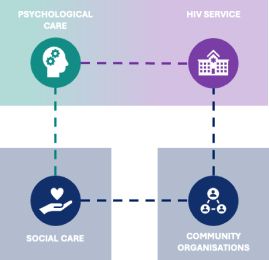

Lead health care professional delivering psychological care. Often this service will be separate from the HIV service – some larger clinics have access to in-house psychological support.
A GP may refer someone for physiological care, both psychology and psychiatry. A GP can also support through social prescribing and signposting to other services that can support mental wellbeing.

An HIV Consultant will not oversee psychological care, but should be aware of someone living with HIV’s psychological wellbeing, as well as any medication that is prescribed as part of psychological care.
A specialist nurse will have an active role in monitoring wellbeing, for example working with someone living with HIV to complete PROMs. Nurses will often signpost to other services and may support the co-ordination of care – liaising with other services and working closely with someone living with HIV to understand changing needs.

Community organisations play a vital role in supporting psychosocial wellbeing, including through peer support. They may be commissioned to work within HIV clinics and often help address wider health determinants—such as employment, welfare access, and housing support.
Social services can support in co-ordinating care and assessing someone’s needs for additional support, such as independent living support, as well as sign-posting to community organisations.
Support for stigma and discrimination
National AIDS Trust (NAT) offers free advice and advocacy through its HIV Discrimination Advice Service. A caseworker can provide guidance, advocate on your behalf, or support you in making a formal complaint.
Common issues reported include:
- Refused or delayed medical appointments
- Data breaches
- Denied reasonable adjustments
- Discriminatory treatment in healthcare settings
Examples of NAT’s impact:
- A person living with HIV was refused a tattoo. NAT identified this as direct discrimination under the Equality Act, provided legal context, and wrote to the provider. As a result, the business updated its medical forms and trained staff appropriately.
- In another case, a hospital disclosed a patient’s HIV status without consent. NAT supported the individual in filing complaints with the hospital, the Information Commissioner’s Office, and the Care Quality Commission, thus ensuring accountability and awareness of data protection laws in HIV care.
The power of peer support
Overcoming stigma:
A woman was blackmailed by her ex-partner, who threatened to reveal her HIV status unless she paid him. When he followed through, she experienced severe distress. Through her HIV clinic, she accessed peer support, which continues to help her rebuild confidence and reclaim her life.
Supporting treatment adherence:
A woman struggling to accept her HIV diagnosis was hesitant to begin treatment. With the help of a peer support worker, she explored the benefits of treatment in a safe, non-judgmental space. Her peer even accompanied her when she took her first dose—offering reassurance and solidarity.
- British HIV Association (BHIVA) Standards of Care for People Living with HIV aims to tell you about what you should expect when getting your HIV care: https://www.standards.bhiva.org
- The Terrence Higgins Trust provides resources on mental health and living well with HIV: https://www.tht.org.uk/hiv-and-sexual-health/living-well-hiv/mental-health
- The National AIDS Trust resource explains psychological support for people living with HIV: https://nat.org.uk/publications/psychological-support-for-living-with-hiv/
Quick Navigation


References
- UK Health Security Agency. Positive Voices 2022: Survey report. Available at: https://www.gov.uk/government/publications/hiv-positive-voices-survey/positive-voices-2022-survey-report. Accessed May 2024.
- Gooden et al. The risk of mental illness in people living with HIV in the UK: a propensity score-matched cohort study. The Lancet HIV, 9 (3); 172-181. Accessed May 2024.
- Terrence Higgins Trust. Depression. Available at: https://www.tht.org.uk/hiv-and-sexual-health/living-well-hiv/mental-health/depression. Accessed May 2024.
- British HIV Association. Standards of care for people living with HIV 2018. Available at: https://www.bhiva.org/file/KrfaFqLZRlBhg/BHIVA-Standards-of-Care-2018.pdf. Accessed May 2024.
- Department of Health and Social Care. Towards Zero – An action plan towards ending HIV transmission, AIDS and HIV-related deaths in England – 2022 to 2025. Available at: https://www.gov.uk/government/publications/towards-zero-the-hiv-action-plan-for-england-2022-to-2025/towards-zero-an-action-plan-towards-ending-hiv-transmission-aids-and-hiv-related-deaths-in-england-2022-to-2025. Accessed May 2024.
- British HIV Association. Quality Standards on Psychological Support 2025. Available at: https://bhiva.org/wp-content/uploads/2025/08/Standards-of-Psychological-Support-for-Adults-Living-with-HIV-2025.pdf. Accessed Sep 2025
The contents of the U=U series of videos and The Fifty Over 50 project are the result of collaboration and discussion between MSD and the Whole Person Care Partnership, a collaboration between MSD and several HIV, advocacy, education and scientific organisations, with content agreed on an equal basis between all those involved. MSD are the originators and funders of the initiatives.
Please note not all the images on this website are people living with HIV and may be actors representing the community.


Reporting of side effects.
If you get any side effects with any medicines, talk to your doctor, pharmacist or nurse. This includes any possible side effects not listed in the medicines package leaflet. You can also report side effects directly via the Yellow Card Scheme at https://yellowcard.mhra.gov.uk or by searching for MHRA Yellow Card in the Google Play or Apple App Store. By reporting side effects, you can help provide more information on the safety of medicines. By clicking the above link, you will leave the MSD website and be taken to the MHRA website.
Merck Sharp & Dohme (UK) Limited Registered Office: 120 Moorgate, London, EC2M 6UR, United Kingdom. Registered in England No. 233687
Copyright © 2025 Merck & Co., Inc., Rahway, NJ, USA and its affiliates. All rights reserved.
GB-NON-10235 | Date of preparation: October 2025
